
“‘The peacock’s tail makes me sick!’ said Charles Darwin. That’s because the theory of evolution can’t explain why nature is so beautiful… Taking inspiration from Darwin’s observation that animals have a natural aesthetic sense, philosopher and musician David Rothenberg probes why animals, humans included, have an innate appreciation of beauty” (back cover blurb on his 2012 book Survival of the Beautiful: Art, Science and Evolution).
Our innate appreciation of beauty has led humans (and some animals) to create beautiful art for many centuries – until the 20th century. In modernist and postmodern art and philosophy, the very concept of beauty has been denied and disparaged. Artists, in all the arts, now very often deliberately create ugliness, carefully avoiding any manifestation of beauty (of course, if they can carefully avoid beauty they obviously know what it is, so their denial of the reality of beauty is hypocritical).
I and many others want to bring a recognition of the reality of beauty, and the expression of beauty, back into the arts – not beauty as something slick, glossy or sentimental but a quality with depth to it, something richly allusive.
Is it true though that an aesthetic sense is natural, and that animals can appreciate beauty? The clearest answer to this question is given by bowerbirds. Bowerbirds construct incredibly elaborate “bowers”, abstract sculptures that make striking use of colour and form. Different species of bowerbird have different basic designs (just as different human cultures have different styles in their architecture, art, music etc.), but individual birds add their own personal touches: “Once the basic structure is finished, the customization begins. Some birds line the display floor with fine grasses. Others paint the inner wall of the bower with crushed berries, some even brushing on the berry juice with soft pieces of bark” (Rothenberg, p.8). Yes, you read correctly! A wild bird makes paint by crushing berries (the same way humans made paints for many centuries), then finds a soft piece of bark and uses it as a paintbrush!
Bowerbird bowers do not provide shelter or hiding places, they are simply created to be visually attractive. Once the sculpture and painting is completed, the bowerbird goes on to perform an elaborate song and dance routine – in other words, they are creative artists in every medium available to them.
Some would say “that’s just instinct”, and these behaviours may well be instinctive, but that doesn’t explain away the sense of beauty the birds must necessarily rely on both when they create and respond to these artworks.
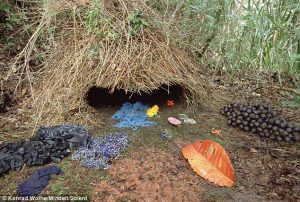
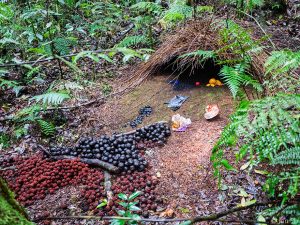
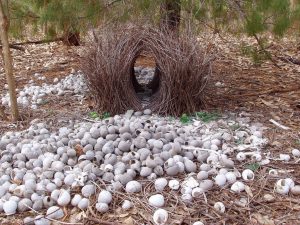
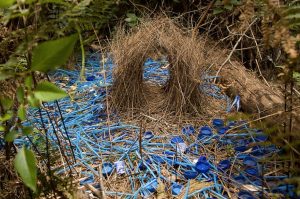
Beauty is real, part of the fabric of nature, not just an idea invented by clever humans. Beauty gives a sense of something “higher”, something beyond the everyday; it lifts the spirits. This is one reason why the denial and disparagement of beauty in so much modern (human) art, music and literature is so damaging to our cultural and mental health: it’s a denial of nature, intuitive wisdom, and the life of the spirit.
My latest composition, called simply Of Beauty, is a setting of words by Lebanese writer, poet and visual artist Kahlil Gibran (1883–1931), one 20th century creative artist who did retain a strong belief in the reality and depth of beauty. Of Beauty is for SATB choir and orchestra. See below for the full text (I have rearranged Gibran’s words – as composers often do when setting prose to music – but have not changed any of his meanings, metaphors or imagery.) This is a video of a virtual performance of Of Beauty with Gibran’s words as subtitles and imagery to match the words (best watched at a higher quality setting, for clearer images):
Some choice quotes about beauty:
“We do not want merely to see beauty… we want something else which can hardly be put into words ― to be united with the beauty we see, to pass into it, to receive it into ourselves, to bathe in it, to become part of it. That is why we have peopled air and earth and water with gods and goddesses, and nymphs and elves.” ― C.S. Lewis
“A horse is a beautiful animal, but it is perhaps most remarkable because it moves as if it always hears music.”
― Mark Helprin, Winter’s Tale
“Those who contemplate the beauty of the earth find reserves of strength that will endure as long as life lasts.” ― Rachel Carson, The Sense of Wonder
“Mathematics expresses values that reflect the cosmos, including orderliness, balance, harmony, logic, and abstract beauty.” ― Deepak Chopra
“Beauty doesn’t have to be about anything. What’s a vase about? What’s a sunset or a flower about? What, for that matter, is Mozart’s Twenty-third Piano Concerto about?” ― Douglas Adams, The Salmon of Doubt
“Man cannot do without beauty, and this is what our era pretends to want to disregard.” ― Albert Camus, The Myth of Sisyphus and Other Essays
“Beauty is unbearable, drives us to despair, offering us for a minute the glimpse of an eternity that we should like to stretch out over the whole of time.” ― Albert Camus, Notebooks 1935-1942
I need to comment on this last quote. Camus was not a happy man, and the quote was written just before or during World War II, when there wasn’t much to be happy about. I personally don’t find beauty unbearable, nor does it drive me to despair, but I do agree with Camus that beauty offers a “glimpse of eternity”.
Further reading
For more insight into the ways 20th century movements in the arts and philosophy have undermined and disparaged the concept of beauty, I highly recommend the following sources, written by people who have very different political views and who are not always in agreement, but who have strikingly similar things to say about the fate of beauty in contemporary western culture:
• Beauty (2009), a small book by English philosopher Roger Scruton
• Beauty Disparaged (2013), an online essay by Australian visual arts academic Jacqueline Millner: https://contemporaryartandfeminism.com/archive/28-2013-exhibitions/67-essay-beauty-disparaged-october-22-2013
Of Beauty
Whispering softly, she speaks in our spirit,
a faint light that quivers in fear of the shadow.
Kind and gentle she walks among us,
a young mother half-shy of her glory.
Beauty shall rise with the dawn from the east,
beauty shall lean from the windows of sunset.
Beauty shall dance with the autumn leaves,
beauty shall leap upon the hills of spring.
Beauty shouts among the mountains,
and with her cries come the roaring of lions,
the beating of wings,
and the sound of hoofs.
Beauty is a thing of might and dread,
like a tempest she shakes the sky,
she shakes the sky above us, she shakes the earth beneath us;
beauty is a thing of might and dread.
Beauty is not a need but an ecstasy,
a heart enflamed, a soul enchanted –
not the image you see, not the song that you hear,
but the image you see though you close your eyes
and a song you hear though you shut your ears.
Beauty is a garden forever in bloom,
a flock of angels forever in flight.
Beauty is life when life unveils her holy face.
But you are life and you are the veil.
Beauty is eternity gazing at itself in a mirror.
But you are eternity and you are the mirror.
― Kahlil Gibran
Hi Neil, thanks for your words on beauty. I have a few thoughts of my own in response. I once sailed with a close friend down the west coast of Tasmania and we entered a place called Bathurst Harbour just after dawn. It is sublimely beautiful there. As we sailed up the channel it would be fair to say we were both overwhelmed. My response was silence, my friends was to chatter incessantly. I asked him to try silence. I note that when faced with sublime beauty, these two responses are often present (more the verbalisations, obsessive photographing etc. I think). Thank you for the Gibran poem, as it evokes quite clearly this dual nature of beauty. It is sublime and uplifting but it is also dreadful and mighty. What is so dreadful I wonder? I think Gibran guides us in this (beautifully) in that beauty is a kind of veil shielding us from something terrifying. Ecstasy, which Gibran opposes to need, is from the Latin exstasis, which is a kind of displacement or removal from place (self). As he goes on he is clear from my reading that the dread is related to eternity (no time) and loss of ‘self’ (you are eternity and you are the mirror). In other words, no ‘you’ to speak of. No wonder we are either struck dumb or so agitated in the presence of beauty. As you say, nothing sentimental there. I’m often aware of an anxiety in the presence of beauty, the need to either try to capture it or to run from it, as if it is too much, so I can relate to the words of Camus and Gibran.
Some more quotes about beauty:
“So what? Don’t we have enough ugliness already? And don’t we know these things already? Why always fight ugliness with ugliness, stupidity with stupidity, displaying still more and more of it? Why not create something beautiful to fight the ugliness with? Not that I am for escapism (although there is nothing wrong with it). René Clair was not an escapist in A Nous la Liberté. And Chaplin never was. No poet ever is. Neither are tulips, willow trees, Louise Brooks, or cranes. But they fight ugliness just by being there, by emanating beauty, peace, truth.”
—Jonas Mekas, Lithuanian-American filmmaker
In 1960, journalist Gordon Young asked psychiatrist Carl Jung, “What do you consider to be more or less basic factors making for happiness in the human mind?” Jung answered with five elements:
1. Good physical and mental health.
2. Good personal and intimate relationships, such as those of marriage, the family, and friendships.
3. The faculty for perceiving beauty in art and nature.
4. Reasonable standards of living and satisfactory work.
5. A philosophic or religious point of view capable of coping successfully with the vicissitudes of life.
It is only through images
that the inner world communicates at all.
Images of the past, shapes of the future.
Images of vigour for a decadent period,
images of calm for one too violent.
Images of reconciliation
for a world torn by division.
And in an age of mediocrity
and shattered dreams,
images of abounding, generous,
exuberant beauty.
– Michael Tippett
“The world is a dream, you say, and it’s lovely, sometimes. Sunset. Clouds. Sky.” “No. The image is a dream. The beauty is real.” – Richard Bach, Illusions
Illam pulchritudinem aeternam quam amat et ad quam tendit omne quod amat. That eternal Beauty which is beloved by, and towards which reacheth, whatsoever loveth. – John Scotus Erigena (John Duns Scotus, “Doctor Subtilis”, ?1265 – 1308, Scottish theologian)
“From pure sensation to the intuition of beauty, from pleasure and pain to love and mystical ecstasy and death – all the things that are fundamental, all the things that, to the human spirit, are most profoundly significant, can only be experienced, not expressed. The rest is always and everywhere silence. After silence that which comes nearest to expressing the inexpressible is music.” – Aldous Huxley, ‘The Rest Is Silence’ in Music at Night (1931)
Another thought-provoking quote on beauty: “One of the terms we poets use in our considerable effort to avoid religious and spiritual terminology is ‘beautiful’. Of course no one can define the word, or everybody defines it differently, and yet we believe in it. Beauty is an article of faith among poets. I think many of us are trying to sidestep religion, and beauty is a word we use to do that.” – Gregory Orr, quoted in Iain McGilchrist, The Matter With Things, p.1259