
… is out now. You can watch and listen to an introductory video here and listen to the entire album here,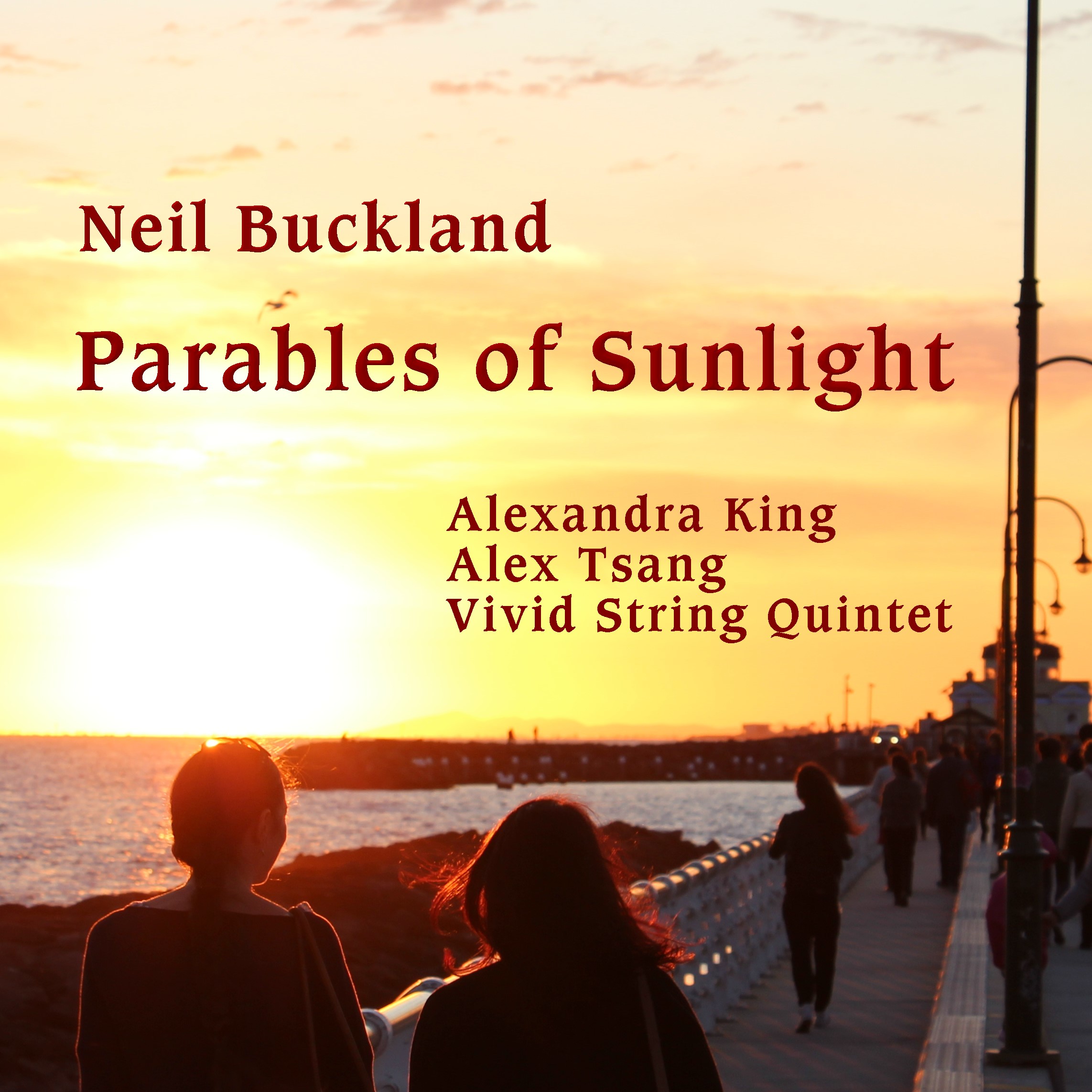
on YouTube Music or on Deezer. (I believe it’s also on some Chinese platforms, including QQ Music).
Parables of Sunlight and the poetry of music
The titles of the four pieces on this album are taken from poetry by the two poets whose language is in my opinion most richly musical of all, Dylan Thomas and Gerard Manley Hopkins. Because their poetry is already so musical I have never considered setting it to music – I think that would be both presumptuous and superfluous. However, there are words and phrases in some of their poems that make perfect titles for the kind of music I write, music that aims to be as allusive as poetry.
The non-literal language in poetry conveys meaning in a way that everyday language (prose) does not: good poetry has a richness, depth and also an openness that prose lacks. By openness I mean not able to be tied down to a specific meaning, or a meaning that can be clearly explained in words. This openness allows the lines and phrases of poetry to express and bring to mind concepts, meanings, feelings and perceptions that go beyond what everyday language has the capacity to express. In fact, when we attempt to convey concepts, meanings, feelings and perceptions like these in everyday language we narrow them, reduce them, take the life out of them. Poetry gives them life, depth, breadth and expansiveness.
This capacity of poetry to convey deeper and broader meanings through non-literal language is exactly what music (another non-literal language) does. When music is combined with words (the lyrics of songs), the music enriches and deepens the meanings of the words; and when music stands alone (in instrumental music), it can take meanings even further, to regions where words are inadequate.
Some information about the individual tracks on the album:
Parables of Sunlight
Driving through the Tasmanian countryside one sunny day, with green fields and gently rolling hills on either side of the road, I noticed the few dense, white clouds drifting across the sky were casting deep shadows that moved swiftly across the land, creating shifting patterns of shadow and bright sunlight, patterns that brought up in me unexplainable feelings of depth and meaning.
The music of Parables of Sunlight is not an attempt to describe that scene, but to reflect the feelings it evoked.
Most of my music goes through many revisions and reworkings, but I wrote Parables of Sunlight rapidly in a single session, later making only very few and very minor revisions.
The title derives from Dylan Thomas’ incredibly evocative ‘Poem in October’:
…all the gardens
Of spring and summer were blooming in the tall tales
Beyond the border and under the lark full cloud. …
And I saw… a child’s
Forgotten mornings when he walked…
Through the parables
Of sun light
And the legends of the green chapels
And the twice told fields of infancy…
The Heart Falls as Light
The other three pieces on this album are all more recent, part of a collection of pieces that take their titles from lines in the poetry of Gerard Manley Hopkins.
This piece takes its title from the following lines in Hopkins’ ‘The Handsome Heart’:
Heart to its own fine function, | wild and self-instressed,
Falls as light…
I can’t really tell you what these lines mean; my response to them is intuitive. ‘Self-instressed’ probably means something like ‘self-energized’ (the word ‘instressed’ is Hopkins’ invention), but knowing that makes little difference. Attempts to precisely define the meaning of poetry in any case often undermine its beauty, and risk losing sight of meaning altogether. (This makes sense when you consider that meaning is perceived by the intuitive right side of the brain rather than the analytical left brain, as psychiatrist and neuroscience researcher Iain McGilchrist has pointed out.)
As with poetry, so with music. Although I wrote this music myself, I can’t tell you exactly what it means; I can only say that the words ‘heart’, ‘falls’ and ‘light’ – the key words in those lines by Hopkins – all have multiple associations in my mind (as they surely do in everybody’s), that when the words are combined the way Hopkins has, they bring up even more associations, suggestions and implications, and that this music resonates (at least in my mind) with those associations.
Immortal Diamond
The words ‘immortal diamond’ memorably conclude Hopkins’ poem ‘That Nature is a Heraclitean Fire and of the comfort of the Resurrection’ (see the full poem below). I wrote this music with those final words and all they might represent in the back of my mind, and also (like Hopkins, I suspect) the qualities of a literal diamond, its facets and angles, its purity and clarity, and how these qualities might be reflected in a metaphorical, ‘immortal’, diamond.
The ‘Heraclitean fire’ of the poem’s title refers to the teachings of the Greek philosopher Heraclitus, who wrote that the world (or cosmos) is an ‘ever-living fire kindling in measures and being extinguished in measures’, that ‘all things are an equal exchange for fire, and fire for all things’. In Heraclitus’s philosophy, change is constant, and fire symbolises, amongst other things, the flickering flame of impermanence.
But it’s not necessary either to understand ancient Greek philosophy or to share Hopkins’ Christian faith in order to appreciate the beauty and deeper meaning of this poem, or to sense intuitively what the words ‘immortal diamond’ conjure up. (This poem, by the way, is probably the pinnacle of Hopkins’ word-music.)
Cloud-puffball, torn tufts, tossed pillows | flaunt forth, then chevy on an air-
Built thoroughfare: heaven-roysterers, in gay-gangs | they throng; they glitter in marches.
Down roughcast, down dazzling whitewash, | wherever an elm arches,
Shivelights and shadowtackle ín long | lashes lace, lance, and pair.
Delightfully the bright wind boisterous | ropes, wrestles, beats earth bare
Of yestertempest’s creases; | in pool and rut peel parches
Squandering ooze to squeezed | dough, crust, dust; stanches, starches
Squadroned masks and manmarks | treadmire toil there
Footfretted in it. Million-fuelèd, | nature’s bonfire burns on.
But quench her bonniest, dearest | to her, her clearest-selvèd spark
Man, how fast his firedint, | his mark on mind, is gone!
Both are in an unfathomable, all is in an enormous dark
Drowned. O pity and indig | nation! Manshape, that shone
Sheer off, disseveral, a star, | death blots black out; nor mark
Is any of him at all so stark
But vastness blurs and time | beats level. Enough! the Resurrection,
A heart’s-clarion! Away grief’s gasping, | joyless days, dejection.
Across my foundering deck shone
A beacon, an eternal beam. | Flesh fade, and mortal trash
Fall to the residuary worm; | world’s wildfire, leave but ash:
In a flash, at a trumpet crash,
I am all at once what Christ is, | since he was what I am, and
This Jack, joke, poor potsherd, | patch, matchwood, immortal diamond,
Is immortal diamond.
– Gerard Manley Hopkins
Wandering on the World
This title comes from Hopkins’ ‘Ash-boughs’:
Not of all my eyes see, wandering on the world,
Is anything a milk to the mind so… as a tree whose boughs break in the sky.
They touch heaven, tabour on it; how their talons sweep
The smouldering enormous winter welkin!
… it is old earth’s groping towards the steep
Heaven whom she childs us by.*
I chose this title partly because of the vivid nature imagery in this passage and partly because the music of Wandering on the World moves around the tonal world or cosmos – the circle of 5ths – not in the usual descending direction but by ascending 5ths, as if wandering on a world it’s not quite at home in.
That small word ‘on’ fits this aspect of the music perfectly: wandering on the world, it seems to me, is not at all the same as wandering around the world or in the world: the wanderer on the world seems separate from or above the world rather than a part of it, on the world in the way that an astronaut is said to be on the moon or on another planet. When astronauts return home, we say they are back on earth – but only when they first arrive; soon they are back in this world, back in America or Russia or wherever they came from. That little two-letter word, on, makes the wanderer seem a detached observer, almost like an alien from another planet who has descended onto the earth and is here only as a visitor.
—————————-
Currently there is a technical hitch preventing the release of the Parables of Sunlight album on Spotify, Apple Music and Amazon. The nature of the problem has not been explained to me, but I am hoping to have it sorted out soon. In the meantime, synthesized versions of the above 4 compositions are available on all three of those platforms – but I recommend listening to these new recordings with real musicians if at all possible, on YouTube or Deezer.
If you would like to purchase mp3s or a CD of this music directly from me, or have any other queries or comments, please contact me here or via listen@neilbucklandmusic.com.
—————————
* The suggestions of animism or nature mysticism in Hopkins’ poetry may seem surprising given that he was a Catholic priest, but he did not see this as incompatible with his religious beliefs (for more on this see, e.g., https://mahabahu.com/gerard-manley-hopkins-on-nature-and-god/).
Leave A Comment